Skip to product information
1 of 1
Author: @Cézjah
Talk to Author
  • Summaries
  • Videos
  • Podcasts
  • PowerPoints
  • Glossary

Birth of a Corpse? Affective Consciousness, Perspectival Identity, and the Unbridged Gap in Artificial Feeling

Can a machine feel? Mark Solms and his team say their artificial agent may already do so. It keeps three distinct needs within viable bounds, infers its own condition only through a Markov blanket, and chooses its actions by minimizing expected free energy, the quantity at the heart of Karl Friston's free energy principle. On their account, feeling is a valenced, qualitatively distinctive, selectively prioritized state, and affect, not perception or cognition, is the root of consciousness. An agent that must feel its way through uncertainty about its own needs has, they argue, a point of view of its own.

I take that architecture seriously, and I agree with far more of it than I dispute. We share the definitions: affect is the broader regulatory domain, feeling is its conscious form, and consciousness is the presence of something it is like. We agree that the hedonic place preference test, the zebrafish-and-cocaine experiment that researchers voted the best behavioural sign of consciousness, proves little on its own, and that mechanism, not behaviour, must decide.

The disagreement is narrow and decisive. Solms holds that objective affective value and subjective feeling are “a different observational perspective upon one and the same value,” so that “there is no further operation” to explain. I argue that this perspectival identity is a metaphysical assumption on which the consciousness claim depends. A value can matter to a system functionally, changing its regulation and its choices, without mattering phenomenologically, as something felt by a subject. A computational signal can move an agent without becoming a sign that means anything to it. The architecture establishes the first of each pair; it does not establish the second.

My position is epistemically conservative. I preserve the distinction between physiological or computational affect and phenomenological feeling, I mark their relation with a deliberate question mark, and I set out a tripartite ontology, physiological affect → ? → phenomenological feeling → cognitive-semiotic emotion, that keeps the open question open. Until the bridge is justified, the engineered agent may be the birth of artificial feeling, or an exquisitely animated corpse: everything a feeling does, with no one feeling it.

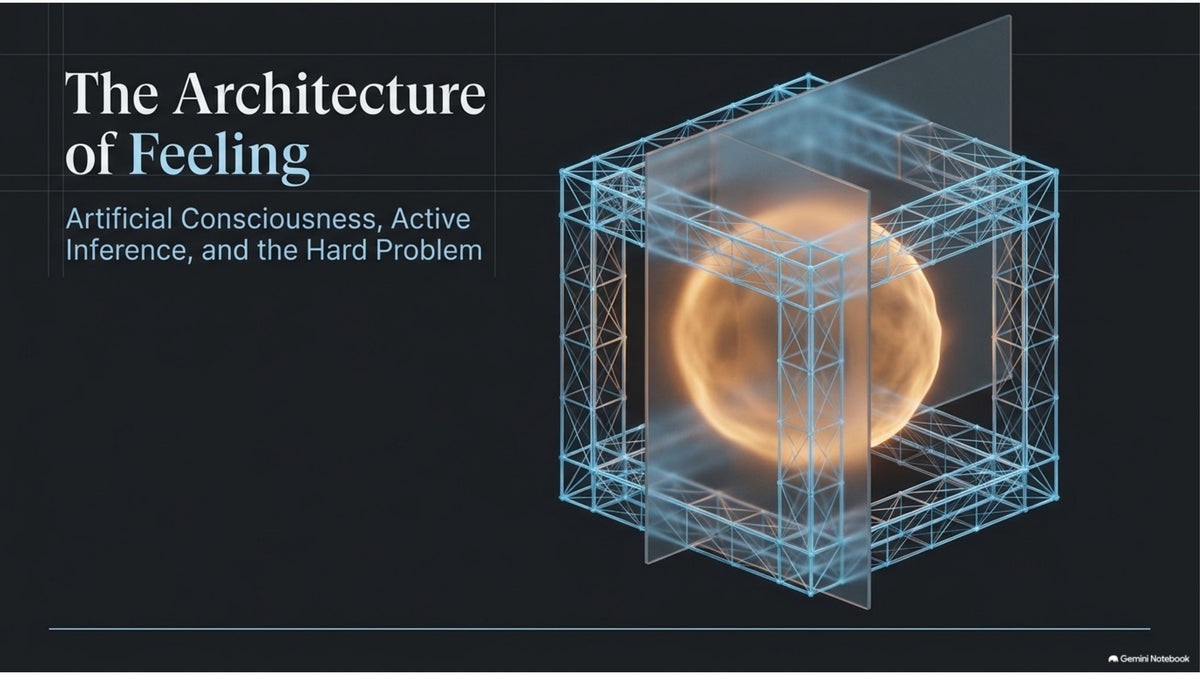
This page gathers the Birth of a Corpse? videos and podcast, the working paper and its scholarly record, a dedicated glossary, and the slide deck The Architecture of Feeling: Artificial Consciousness, Active Inference, and the Hard Problem. A companion to How to Design an Emotion: The Deconstruction and Computation of Emotional Meaning from First Principles (New Intellectual LLC, 2026).

Show More...

God Father: Birth of a Corpse? | The Conscious AI Debate

Birth of a Corpse? examines whether Mark Solms and his team have created genuinely conscious AI or merely a computational system that models the functions of affect and feeling without establishing phenomenological experience.

Play Now
01:35

Birth of a Corpse? | The Conscious AI Debate PT I

Birth of a Corpse? examines whether Mark Solms and his team have created genuinely conscious AI or merely a computational system that models the functions of affect and feeling without establishing phenomenological experience.

Play Now
08:34

Birth of a Corpse? | The Conscious AI Debate Part II

Birth of a Corpse? examines whether Mark Solms and his team have created genuinely conscious AI or merely a computational system that models the functions of affect and feeling without establishing phenomenological experience.

Play Now
06:14
Birth of a Corpse? | The Conscious AI Debate

Birth of a Corpse? | The Conscious AI Debate

Birth of a Corpse? examines whether Mark Solms and his team have created genuinely conscious AI or merely a computational system that models the functions of affect and feeling without establishing phenomenological experience.

AI & Consciousness: The Architecture of Feeling

AI & Consciousness: The Architecture of Feeling

The Architecture of Feeling: Artificial Consciousness, Active Inference, and the Hard Problem. A slide deck for Birth of a Corpse? | The Conscious AI Debate by Cézjah (New Intellectual LLC). Mark Solms and colleagues argue that an artificial agent built on homeostatic need, active inference, and a Markov blanket can instantiate affective consciousness. The deck walks through the architecture, the hedonic place preference test, and the perspectival identity thesis, and shows where the step from functional mattering to phenomenological feeling is assumed rather than shown.

  • Browse Now...
    Category: Non Fiction
    Tags: Online
    View full details
    Close

    Thank You for Your Interest!

    You’ve successfully signed up to be notified when the next release of AI & Consciousness is available. We’re thrilled to share this journey with you and will keep you updated with the latest release information.

    Stay Connected

    Make sure you don’t miss any updates! Subscribe to our newsletter for exclusive release news, insights from the author, and special content directly to your inbox.

    We can’t wait to share the official release of AI & Consciousness with you. Happy reading!