Skip to product information
1 of 1
Author: @Cézjah
Talk to Author Buy Now
  • Summaries
  • Videos
  • Podcasts
  • PowerPoints
  • Glossary

Part IV · The Construction of Emotion

In Part IV, I answer the question Part III leaves open: you construct your emotions. The world supplies the occasion; you supply the meaning. I call this view Emotional Constructivism and give it a working architecture. Most theories melt affect, feeling, and emotion into one process, so they cannot explain why the same feeling supports different emotions, and they strip emotion of accountability. I weigh the leading theories in a Weighted Sum Model trade study against the standards of Parts II and III, and I keep what survives: from Lisa Feldman Barrett, that we construct emotions rather than discover them; from appraisal theory, that significance and goals matter; from Klaus R. Scherer, the phases of an episode; from Jaak Panksepp, affect grounded in ancient brain systems. I alone set the criteria and the scores, so the study measures fit to my architecture, not truth. I define affect as the body’s physiological substrate, feeling as conscious awareness of that affect, and emotion as a goal-governed, context-sensitive act of interpretation by which an agent assigns meaning and significance to a feeling.

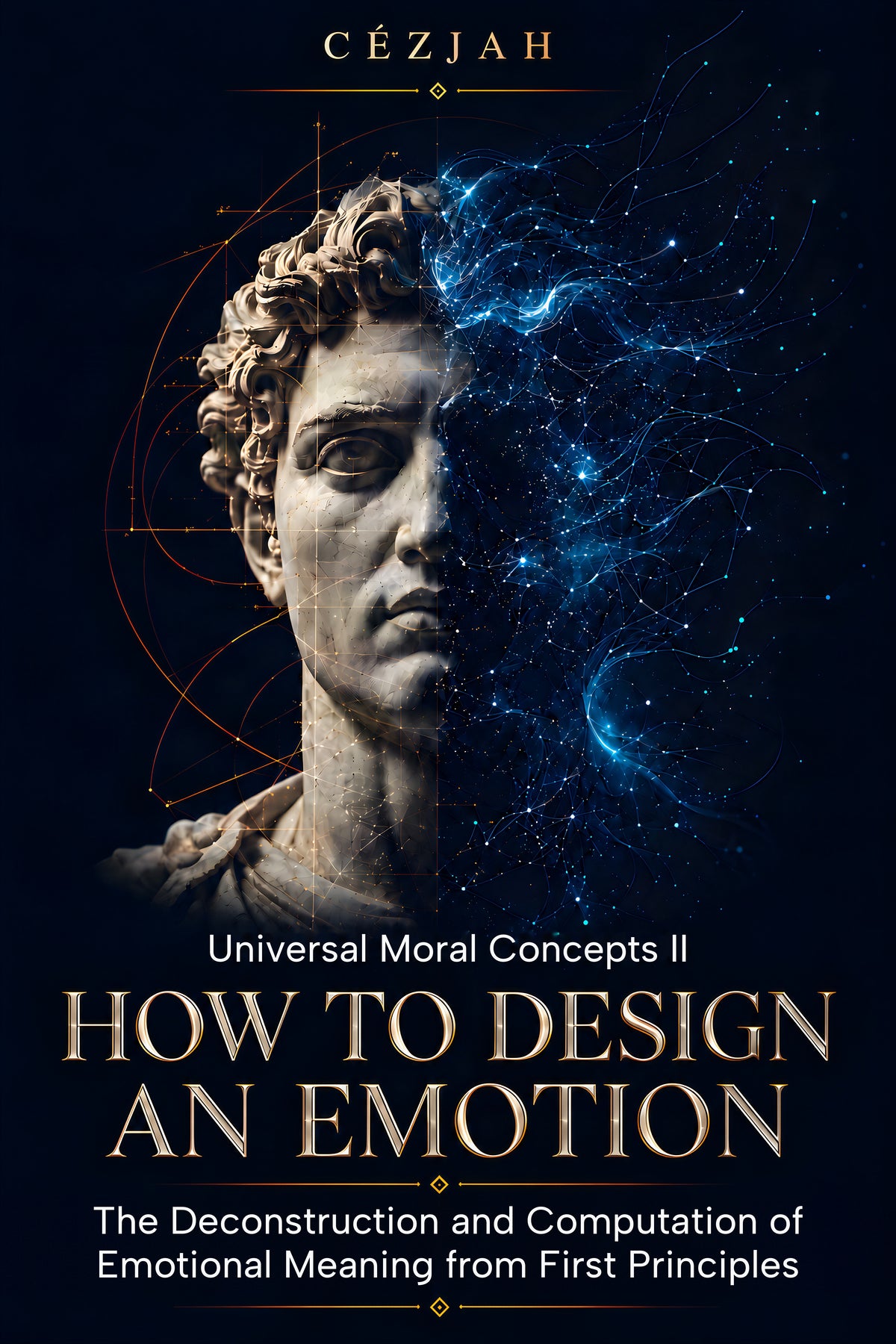
Interpretation proposes candidate meanings, and commitment, a notion I extend from Robert Brandom, makes one of them binding. The Constructivist Semiotic Model of Emotions carries the sign into emotional life through a thirteen-stage flow, with a pause before commitment, and five programs check that the distinctions hold. What is shared: emotions are made, not triggered. What is new: layer separation, correctness conditions, and agentic redesign as the defining commitment. Chapters: 9. Emotions Are Made, Not Triggered. Appendices: Appendix G: Selecting the Candidates: Why These Emotion Theories Made the Cut; Appendix H: The Metric of Emotion: Weighting and Justifying the Comparative Framework; Appendix I: Macro to Micro: Justifying Weights Across Governing Domains; Appendix J: Evaluating the Models: Scoring Rationales and Weighted Matrix; Appendix K: Building an Emotional Mind: A Constructivist Computational Model of Emotions; Appendix L: Where Appraisal Ends and Interpretation Begins: A Constructivist Theory of Emotion; Appendix M: Emotional Constructivism: A Formal Architecture of Emotion as Interpretive Sign. Part IV of How to Design an Emotion: The Deconstruction and Computation of Emotional Meaning from First Principles (Universal Moral Concepts, book III).

Book page: https://newintellectual.com/how-to-design-an-emotion . Buy on Amazon . Key concepts Emotional Constructivism. “The world supplies the occasion; you supply the meaning.” (Chapter 9) Constructivist Semiotic Model of Emotions. “A formal cognitive-semiotic architecture that specifies the constituents, relationships, and constraints through which an agent constructs emotional meaning.” (Glossary) Affect. “The physiological and regulatory substrate, including valence, arousal, and motivational intensity, that generates the conditions of feeling without itself constituting feeling or emotion.” (Glossary) Feeling. “The conscious metaperceptual awareness of a semiotically available affective experience with a distinctive affective character.” (Glossary) Emotion. “A goal-governed, context-sensitive semiotic interpretive act by which an agent assigns meaning and significance to feeling.” (Glossary) Ontological collapse.

“The conflation of physiological affect, feeling, and emotion into stages of a single process.” (Glossary) Commitment. “The normative act by which an interpreter authorizes one interpretation as emotionally binding, so that it admits correctness, error, justification, and revision.” (Glossary) Interpretive governance. “The location of emotional meaning in an act an agent performs, so that the meaning admits correctness, error, justification, revision, and responsibility.” (Glossary) Weighted sum model. “The trade-study method that scores candidate theories against weighted definitional, analytic, cognitive-semiotic, and computational criteria and sums the weighted scores into a total.” (Glossary) Constructivist Interpretation Theory of Emotion. “The theory that interpretation, not appraisal, constructs emotional meaning; it marks where appraisal ends and interpretation begins.” (Glossary) Constructivist Computational Model of Emotions. “I address the fourth problem through the Constructivist Computational Model of Emotions, answering a fundamental computational question: can emotional construction survive formal representation as an executable architecture?” (Introduction)

Show More...

Part IV: The Construction of Emotion (Deep Dive)

Do emotions happen to you, or do you make them? The world supplies the occasion; you supply the meaning. This deep dive takes apart Part IV of How to Design an Emotion: The Construction of Emotion, from separating affect, feeling, and emotion to the Constructivist Semiotic Model of Emotions.

Play Now
24:20
The Construction of Emotion (Deep Dive)

The Construction of Emotion (Deep Dive)

In this episode of Analyze This, Dr. Ethan Fox, the psychiatrist in the novel God Father by Cézjah, also the author of How to Design an Emotion, directs two AI pundits through Part IV: The Construction of Emotion. The world supplies the occasion; you supply the meaning. This episode lays out Emotional Constructivism. Most theories melt affect, feeling, and emotion into one process, so they cannot explain why the same feeling supports different emotions, and they strip emotion of accountability. The leading theories are weighed in a Weighted Sum Model trade study, keeping what survives from Lisa Feldman Barrett, appraisal theory, Klaus R. Scherer, and Jaak Panksepp. Affect is the body's substrate, feeling is awareness of it, and emotion is a goal-governed act of interpretation. Interpretation proposes; commitment, extended from Robert Brandom, makes one meaning binding, mapped in the thirteen-stage Constructivist Semiotic Model of Emotions. Framework: Part IV · The Construction of Emotion From: How to Design an Emotion (Universal Moral Concepts II) Author: Cézjah (Cecil John) Scholarly / DOI landing: https://newintellectual.com/how-to-design-an-emotion/part-4 DOI: https://doi.org/10.5281/zenodo.23631003 Book product: https://newintellectual.com/products/how-to-design-an-emotion Site: https://cezjah.com The views expressed in this podcast are not necessarily those of the author.

The Construction of Emotion (How It Works)

The Construction of Emotion (How It Works)

The how-it-works edition of Analyze This, companion to the value-proposition episode. Dr. Ethan Fox directs two AI pundits through the mechanics of Part IV: The Construction of Emotion — how the model defines affect, feeling, and emotion, why none can stand in for another, and how it is tested.

Part IV: The Construction of Emotion

Part IV: The Construction of Emotion

Detailed deck for Part IV: The Construction of Emotion from How to Design an Emotion (Universal Moral Concepts II) by Cézjah (New Intellectual LLC). The world supplies the occasion; you supply the meaning. This deck lays out Emotional Constructivism. Most theories melt affect, feeling, and emotion into one process, so they cannot explain why the same feeling supports different emotions, and they strip emotion of accountability. A Weighted Sum Model trade study keeps what survives from Barrett, appraisal theory, Scherer, and Panksepp. Affect is the body's substrate, feeling is awareness of it, and emotion is a goal-governed act of interpretation. Interpretation proposes; commitment makes one meaning binding, mapped in the thirteen-stage Constructivist Semiotic Model of Emotions.

  • Browse Now...
    Category: Non Fiction
    Tags: Online
    View full details
    Close

    Thank You for Your Interest!

    You’ve successfully signed up to be notified when the next release of Part IV · The Construction of Emotion is available. We’re thrilled to share this journey with you and will keep you updated with the latest release information.

    Stay Connected

    Make sure you don’t miss any updates! Subscribe to our newsletter for exclusive release news, insights from the author, and special content directly to your inbox.

    We can’t wait to share the official release of Part IV · The Construction of Emotion with you. Happy reading!